

DryDecon™ Defense Decontamination Technology
The fog produced by traditional fogging devices is composed of large particles that precipitate to the surface after being released. As a result, dispersed particles are not spread evenly, do not penetrate deeply into surfaces, and cannot reach isolated spaces or elevated objects effectively.
Vapor generating devices seek to overcome the issue of even distribution but have proven to be incapable of complete decontamination due to greatly reduced efficacy of decontaminate particles in a gaseous state. As a result, vapor technology is forced to use dangerously toxic chemical concentrations yet still fall short of complete decontamination.
For years, decontamination has relied on these insufficient methods of decontamination and disinfection. Efforts to avoid damaging sensitive equipment and valuable materials have led to practices that are incomplete, highly toxic and, in many cases, result in cross-contamination of spaces rather than elimination of the problem.
DryDecon™ changes all of this.
DryDecon™ Technology is the patented approach to decontamination and disinfection that rapidly converts any certified solution into a submicron aerosol which diffuses throughout an entire enclosed space. DryDecon™ delivers decontaminant evenly and thoroughly, even deep within the most complex fabrics or microscopic cracks.
Designed for versatility and not constrained by any one decontaminant or disinfectant solution, DryDecon™ Technology has the capability and the flexibility to handle any threat, chemical or biological.
Disinfection
Submicron particles created by DryDecon™ are small enough to allow disinfectant to enter the viral envelope and destabilize it from the inside out.
Decontamination
DryDecon™ particles neutralize chemical agents using the decontaminant of your choice without damage or corrosion to your property.
Odor Control
DryDecon™ particles remove and prevent stench of any kind by neutralizing their source and penetrating the spots where odors hide.
Laboratory & Scientific Validation for DryDecon™
- First Line Technology PAA test against simulants (Oct. 2024 & May 2025)
- Decon Efficiency Testing: Avarint Laboratories (March 2024)
- Sewage Test (January 2024 & March 2025)
- Academic Testing: Fordham University (February 2023)
- Commercial Laboratory Testing: Microchem Laboratory (August 2022)
How DryDecon™ Works
The DryDecon™ Defense D50 System produces submicron (i.e. 0.5 – 1 μm diameter) decontaminant droplet particles as compared to larger (i.e. 5 – 20 μm diameter) droplets produced by the best competitive foggers.
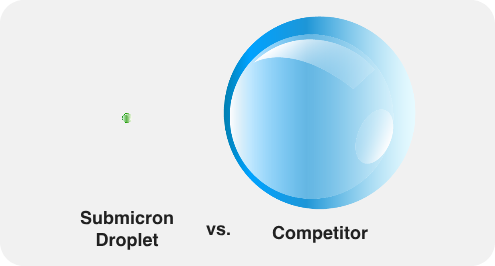
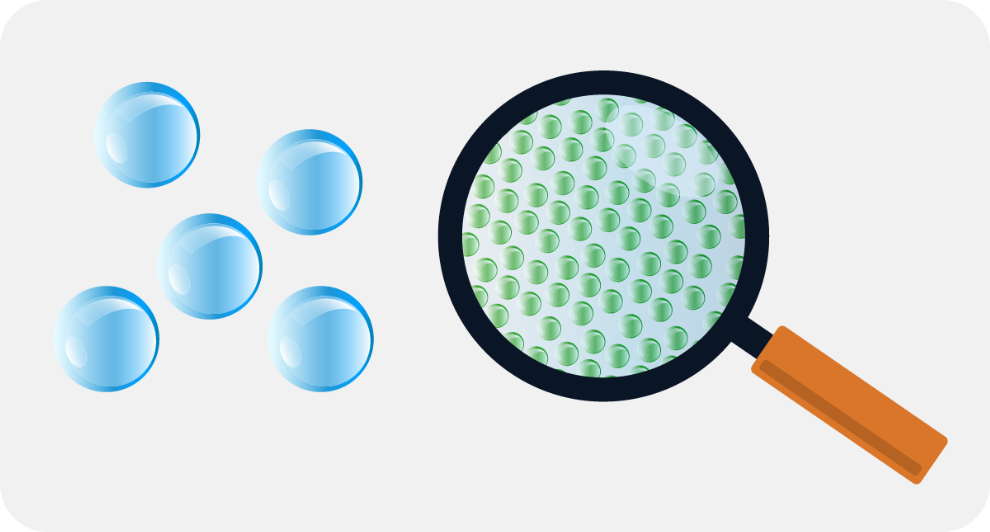
In filling a given space, DryDecon™ Defense produces over 500x the droplets of traditional systems, creating an 800% larger surface area that eliminates bacteria, viruses and pathogens faster and more effectively.
The submicron size allows particles to diffuse in a gas-like fashion, ensuring no part of the room is missed without the long exposure time and high chemical concentration of actual gas systems.
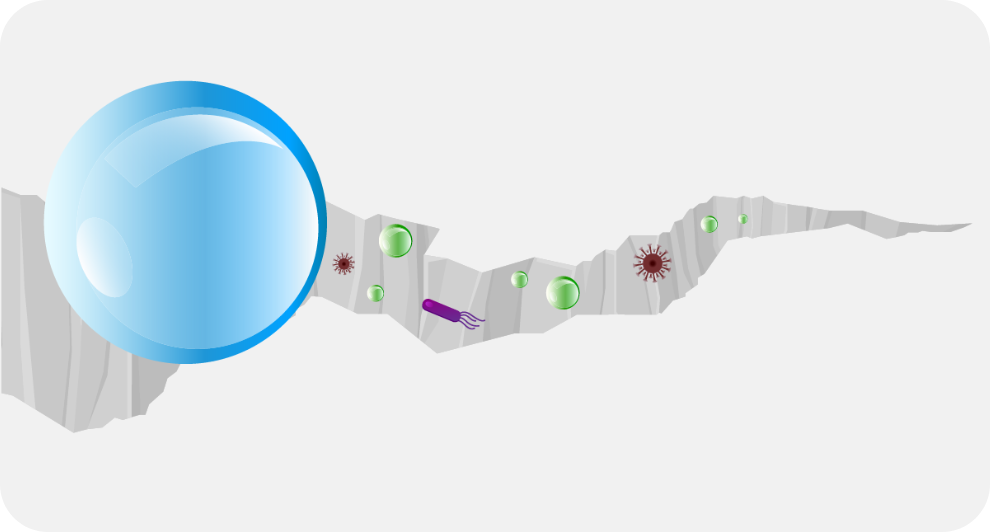
Compared to large fogger droplets, which form hydrogen bonded cohesive layers over cracks, our submicron aerosol delivers decontaminant inside porous surfaces, small crevices and deep inside webbing materials.
The submicron size allows particles to diffuse in a gas-like fashion, ensuring no part of the room is missed without the long exposure time and high chemical concentration of actual gas systems.

DryDecon™ Defense Makes Traditional Fogging Technology Obsolete
| Technology | Droplet Size | Key Features | Best Uses | Pros | Cons |
|---|---|---|---|---|---|
| DryDecon Submicron Aerosol (<1 μm) | 0.1 – 0.9 μm | Submicron aerosol penetrates microscopic crevices and increases decontamination surface area. | Any enclosed space, including all uses listed below. | Thorough delivery of EPA-labeled neutralizing agents on surfaces and deep within complex structures and materials. | None |
| ULV (Ultra-Low Volume) Fogging | 2.5 – 20 μm | High-velocity mist; combines air and surface coverage | Farms, warehouses, offices | – Partially efficient for surface disinfection | – Wets surfaces – Large droplets block cracks and crevices |
| Dry Fogging (Thermal or Cold) | 1 – 10 μm | Vapor-like mist, low moisture | Clean rooms, poultry, hatcheries | – Minimal moisture – Mostly effective in enclosed spaces | – Inconsistent particle size – Larger droplets, block cracks and crevices – Excessive heat alters decontaminant’s effectiveness |
| Electrostatic Sprayers | 30 – 100 μm | Electrically charges droplets to “wrap” around surfaces | Equipment, walls poultry cages | – High surface coverage – Clings to 3D surfaces | – Larger droplets, block cracks and crevices – Damages electronic equipment |
| Traditional Misting Systems | 20 – 100+ μm | Simple nozzle-based spray | Cooling, dust control | – Inexpensive – Easy setup | – Very large droplets – Leave residue and wetness |